Glossary
Community engagement glossary
Plain-language definitions of the terms planning, design, and engineering teams use to involve the public — from charrettes to spatial surveys to participatory budgeting.
Foundations
Community engagementCommunity engagement is the process by which planning, design, and engineering teams involve the public in decisions that affect their neighborhoods — gathering local knowledge, surfacing concerns, and building support before a plan or project is finalized. In planning practice it spans everything from informing residents to actively collaborating with them on outcomes.Public participationPublic participation is the practice of involving people in the decisions that affect their lives — in planning, it means giving residents and stakeholders a genuine role in shaping projects, plans, and policy rather than simply notifying them after the fact. It is the core principle behind community engagement and is often structured along a spectrum from informing to empowering.Stakeholder engagementStakeholder engagement is the structured process of identifying, communicating with, and involving the individuals and groups who have an interest in or are affected by a project. In planning it covers residents, businesses, agencies, advocacy groups, and elected officials, and aims to understand their interests and manage their influence throughout a project.
Methods
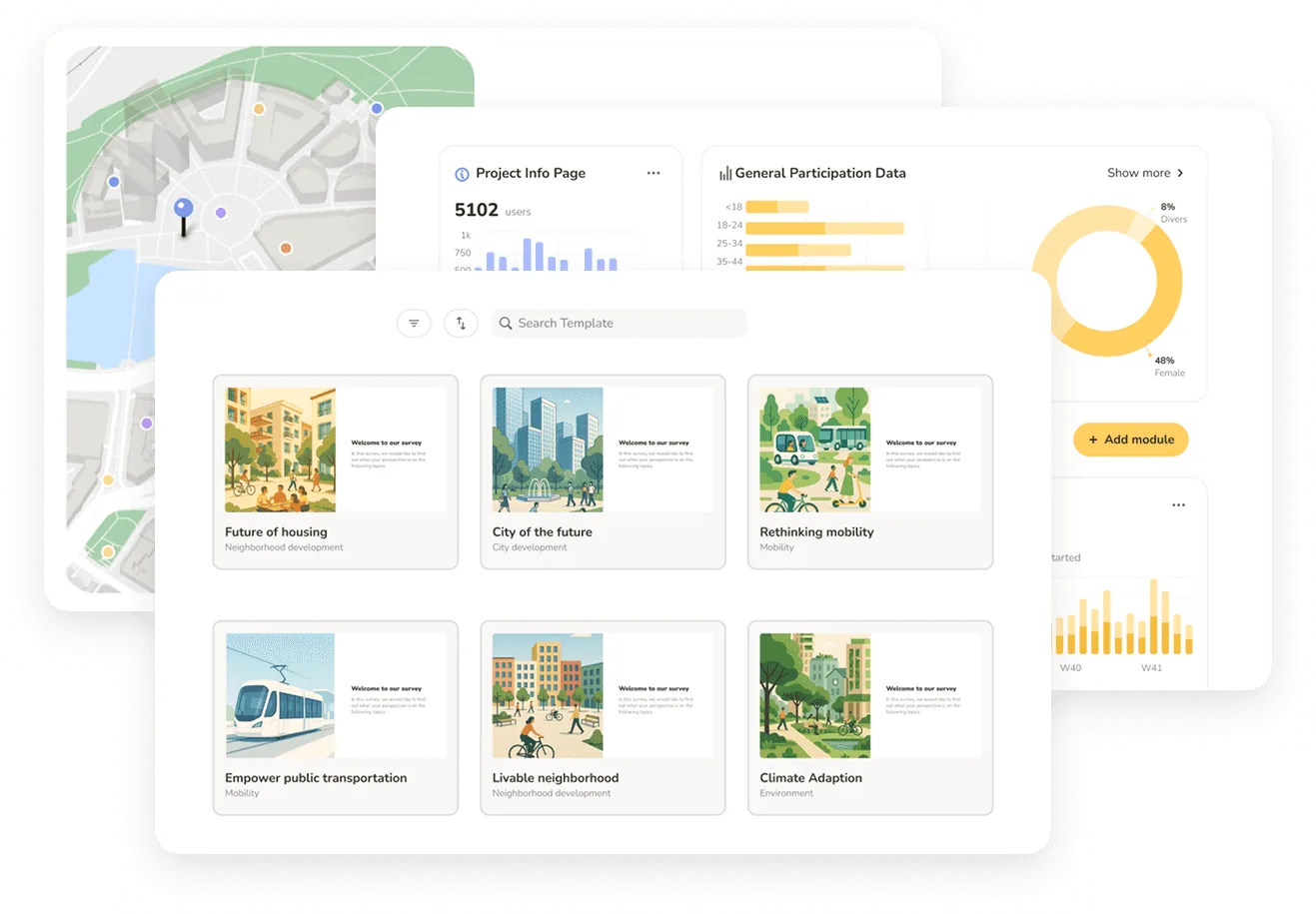
Participatory budgetingParticipatory budgeting (PB) is a democratic process in which residents decide directly how to spend part of a public budget. A government or agency sets aside a defined amount of money, the community proposes and develops spending ideas, and residents vote on which projects are funded. In German-speaking contexts it is known as Bürgerhaushalt.CharretteA charrette is an intensive, collaborative workshop in which planners, designers, stakeholders, and community members work together over a short, concentrated period to produce a design or plan. The format is built around rapid cycles of drawing, feedback, and revision so that competing interests are reconciled into a shared vision quickly.Spatial surveyA spatial survey is a survey in which respondents answer by interacting with a map — dropping pins, drawing routes or areas, and attaching comments to specific locations. Instead of abstract opinions, it captures place-based input that can be analyzed geographically, making it well suited to planning, transportation, and public-space projects.
Process
Public commentPublic comment is formal input the public submits on a proposed plan, project, or regulation, usually during a defined comment period. Agencies are typically required to accept, document, and respond to public comments, and the resulting record becomes part of what decision-makers weigh before approval.Public consultationPublic consultation is the practice of seeking the public's views on a proposal before a decision is finalized. It is a specific level of engagement — gathering feedback on options that have already been drafted — and is often a legal requirement for plans, developments, and regulations.