Go Vocal vs. Senf: 2026 comparison for planning firms
Go Vocal, formerly CitizenLab, is built for local governments that run their own participation platform. Senf is built for the consultancies they hire. Here's where each one fits.

Pascal Fuhr, CEO of Senf
Go Vocal and Senf both run online public engagement with surveys, map questions and AI analysis. The difference is the scope. Go Vocal is licensed by a city or county as its own participation platform, open year-round. Senf is built for project-specific engagement: the planning firms those governments hire, and teams that need an online engagement tool for a single project. I run Senf; Go Vocal facts below link to its own pages or public records, checked on October 18, 2026.
The short answer
Go Vocal fits a local government that runs its own participation platform year-round. Senf is built for project-specific engagement: planning firms delivering engagement on client projects, and anyone who needs an online engagement tool for one project, such as a General Plan update or an Active Transportation Plan. Each project is built from the RFP, free until it goes live, with published pricing, unlimited users and AI analysis included.
Go Vocal vs. Senf at a glance
| Decision area | Go Vocal | Senf |
|---|---|---|
| Built for | Local governments running their own participation platform.Source | Project-specific engagement: planning firms running client projects, or one project such as a General Plan update.Source |
| Pricing | Not published. A UK government listing gives £12,500 to £36,500 a year.Source | Free to build and use in a proposal. $2,500 per project or $9,990 a year for unlimited projects.Source |
| Team seats | 4 admins and 5 project managers on Standard. More on higher plans.Source | Unlimited users.Source |
| Project setup | Templates and a modular toolbox.Source | Built from your RFP, a prompt or a template, in minutes, in the client's brand.Source |
| Map input | Pins, lines and polygons in survey map questions.Source | Points, routes and areas, on your own site plan placed to scale.Source |
| AI analysis | Up to 30 inputs on Standard. Full analysis on Premium.Source | Included on every paid project, against your own tags.Source |
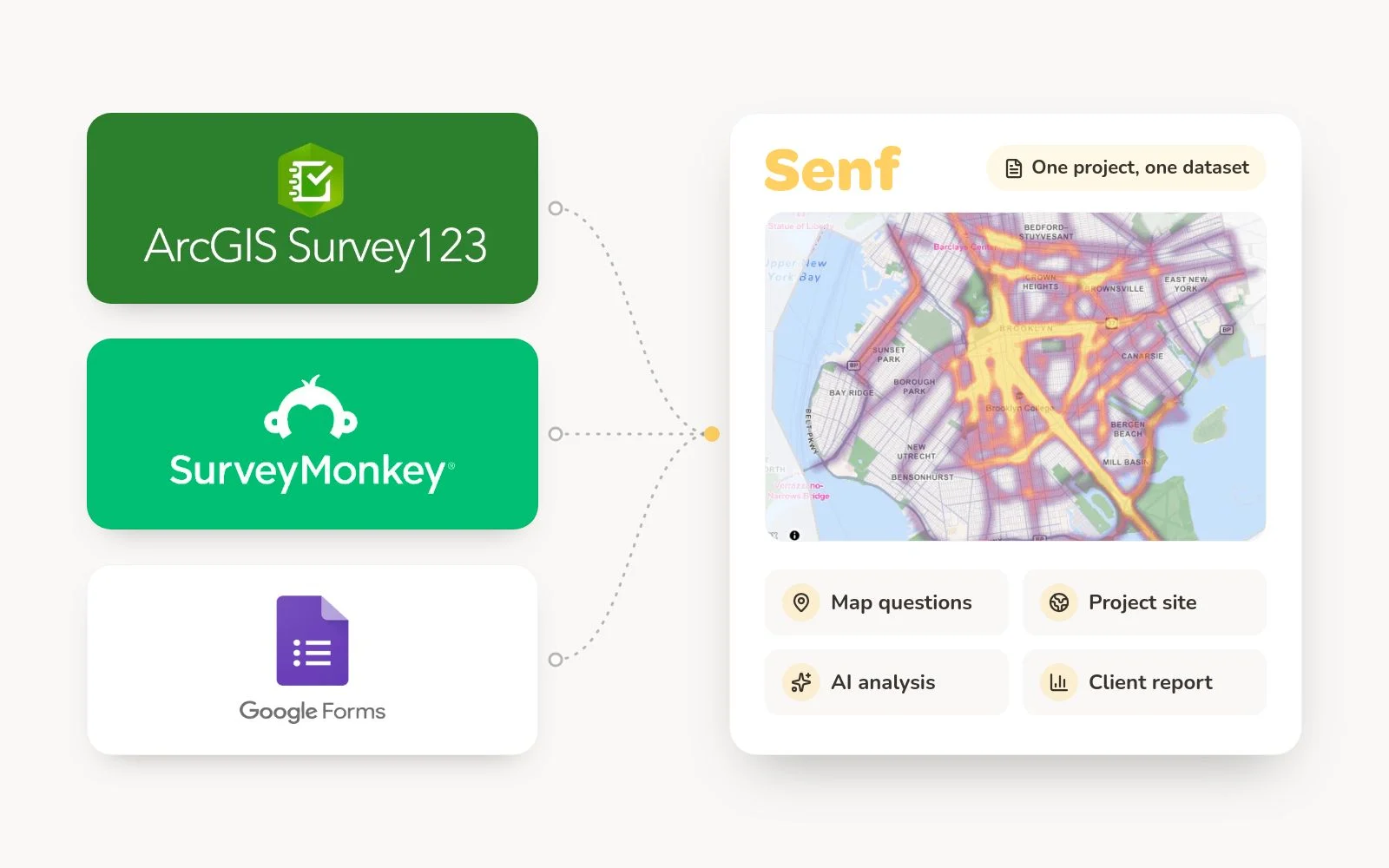
| ArcGIS | Enterprise feature or paid add-on.Source | Live sync to ArcGIS Online, plus GeoJSON and Shapefile export.Source |
Why planning firms choose Senf over Go Vocal
Built for one project, not a standing platform
Go Vocal is an organization-wide platform on an annual license. Senf is licensed per project, so a General Plan update, a Comprehensive Plan or an Active Transportation Plan gets its own engagement site for as long as the project runs, without committing the client to a year-round platform.
A project for every client, starting with the RFP
Upload the RFP and Senf builds the surveys, map questions and project site in the client's brand. The project is free until it goes live, so the client sees a working platform in your proposal. The RFP-to-platform guide shows how.
Pricing you can write into a proposal
Senf costs $2,500 per project, or $9,990 a year for unlimited projects, with unlimited users. Go Vocal doesn't publish prices; a UK government listing gives £12,500 to £36,500 a year, and the City of Wilmington, NC paid $20,900 in 2026. Current plans are on the pricing page.
Comments on your site plan, results in ArcGIS
Residents drop pins, draw routes and outline areas on your actual site plan, placed to scale. Answers sync to ArcGIS Online as they arrive. With Go Vocal, Frome Town Council noted in its April 2026 review that it could not upload its own skatepark design for residents to mark up. See map-based engagement.

Analysis that is done when the survey closes
Senf sorts every open-text comment into your own categories, on every paid project. McKenna ran 2,400-plus comments through it in 90 minutes. Go Vocal's Standard plan analyzes up to 30 inputs; full analysis is a Premium feature.

In the past we would bake in 80 hours of post-production to go through the survey information and make heads or tails of it. Now it's just done.
Brian Reetz
Principal at Design Collective
Go Vocal vs. Social Pinpoint
Go Vocal and Social Pinpoint often share a shortlist. Both are mature platforms sold mainly to public agencies on annual licenses, and neither publishes prices. Go Vocal leans further toward a standing civic platform, with registered residents, proposals and participatory budgeting. Our Social Pinpoint vs. Senf comparison covers Social Pinpoint's seats, map tools and pricing in the same format.
When to choose Go Vocal
A city or county that wants one permanent participation platform, where residents register, follow projects and return over the years. If your client already runs Go Vocal, their standing platform can stay where it is. Senf handles the project work your firm delivers on top.
When to choose Senf
- You run engagement on several client projects at a time.
- You need online engagement for one project, such as a General Plan update or Active Transportation Plan.
- You want a working platform in the proposal, before you win the work.
- Your whole team needs access without counting seats.
- Residents should comment on your site plan, and the results go into ArcGIS.
Frequently asked questions
It depends on who runs the engagement. For a local government that wants one standing participation platform with registered residents and civic tools such as participatory budgeting, Go Vocal is the stronger fit. For a consultancy running engagement on client projects, Senf fits better: a site per project, published pricing, unlimited users and AI analysis included.
Built from your RFP. Free until it goes live.
Compare directly to Go Vocal
Send the RFP you're pursuing and we'll build the engagement project from it, project site and map questions included, so your team can compare it with Go Vocal on a real project.
Free to build and use in a proposal.
Pascal Fuhr, CEO
Senf is the community engagement platform built for private-sector planning, design, and engineering consultancies.
Sources
Vendor pages and public records checked on October 18, 2026.