Community engagement for land development & entitlements
How private-sector development and civil engineering firms run public input that holds up through entitlement review

For a land development or civil engineering firm, community engagement is rarely the headline of an entitlement application — and it is often where approvals stall. Rezonings, conditional use permits, subdivision maps, and site plan reviews almost always pass through a public process, and the record of that process becomes part of what the planning commission and governing body weigh. When neighbors organize against a project, a thin or defensive engagement record is the gap opponents push on. This guide covers what entitlement engagement has to accomplish, why it goes wrong, and how to run a process that gives the approving body a reason to say yes.
Engagement is part of the entitlement, not a courtesy
Most entitlements carry a public-notice and hearing requirement, and many jurisdictions now expect — or formally require — neighborhood meetings or community outreach before an application is deemed complete. Even where it is not mandated, the engagement record is something the staff report describes and the decision-makers read. A planning commission asked to approve a project wants to see that the applicant heard the neighborhood and responded, not that they checked a notice box and waited for the hearing.
That makes engagement a risk-management function as much as a goodwill one. Organized opposition is the single most common reason a sound project gets delayed, conditioned heavily, or denied. A credible, well-documented engagement effort does not guarantee approval, but it removes one of the easiest arguments against the project: that the community was never genuinely consulted.
What the approving body is looking for
That the right people were reached
Notice mailed to a radius is the floor, not the ceiling. Decision-makers respond to evidence that the applicant reached the people actually affected — adjacent owners and tenants, nearby businesses, and neighborhood groups — through channels they would actually see, including digital participation for residents who cannot attend an evening meeting.
That concerns were heard and addressed
The strongest applications show a clear line from what the community raised to what changed in the proposal — a setback adjusted, traffic mitigation added, a use removed. That requires capturing concerns in a structured way and being able to show how each theme was considered, rather than summarizing sentiment in a paragraph.
A record that survives the timeline
Entitlements can run many months across multiple hearings and continuances. The engagement summary, the list of outreach activities, and the comments behind them have to stay consistent and retrievable when a commissioner asks a pointed question late in the process — not be reassembled from email threads and a spreadsheet the week before the hearing.
Where entitlement engagement breaks down
Three failure modes recur. The first is reaching only the opposition: the residents most motivated to attend a meeting are often the ones against the project, so a meeting-only process can make support look thinner than it is. The second is the synthesis gap — comments arrive across cards, emails, and a sign-in sheet, and the team summarizes tone instead of showing how input shaped the plan. The third is reconstruction at the deadline, assembling an outreach record from memory once the hearing is scheduled, after the detail that would have made it persuasive is already gone.
How to run a process that holds up
Lower the barrier to balanced input
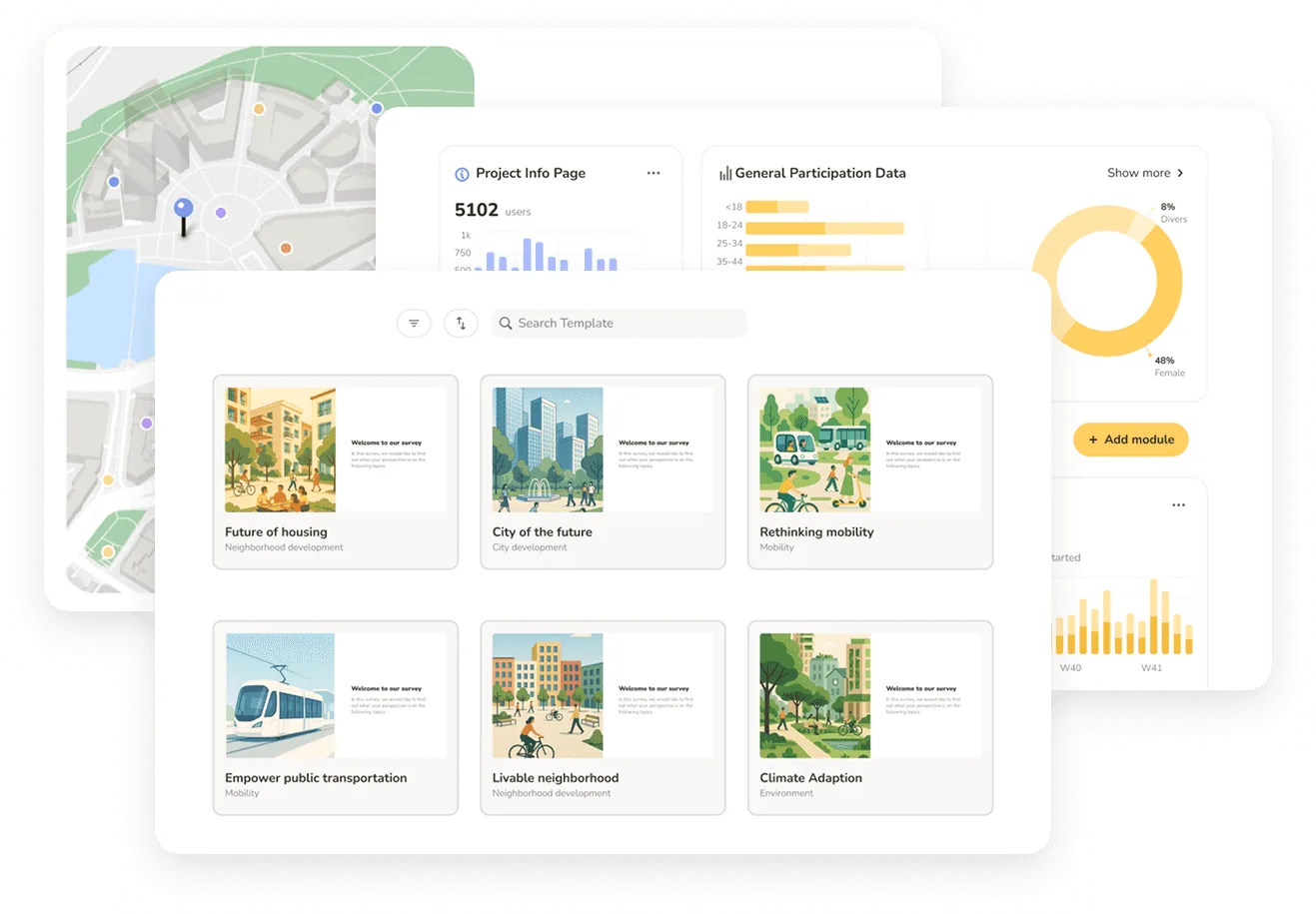
A digital, map-based platform lets residents weigh in on their own time, from a phone, without attending a meeting — which tends to surface the quieter middle of the neighborhood, not just the organized poles. Reaching that broader set of residents is what makes the engagement record representative rather than a transcript of the loudest room.
Make input spatial and specific
Land use concerns are inherently about place — this access point, that building edge, this stretch of street. Map-based questions let residents point to exactly what they mean, which produces input the design team can act on and the staff report can cite, instead of a general comment box that is hard to translate into changes.
Analyze as input arrives
Senf's native AI analysis groups open-text comments into themes as they come in, so the team sees the real concerns emerging during the comment window rather than facing a pile of raw text before the hearing. The firm's judgment still decides what to do about each theme; the platform removes the manual sorting that usually eats the schedule.
Build the hearing-ready record continuously
Because participation, locations, and themes live in one place, the engagement summary for the staff report and the response-to-comments narrative are products of the work, not a last-minute scramble. When a commissioner asks how the applicant addressed neighborhood concerns, the answer is already documented and mapped.
Where Senf fits
Senf is an AI-native community engagement platform built for private-sector planning, design, and engineering consultancies. For a land development or entitlement project, that means one platform to run map-based public input, reach affected residents beyond the hearing room, analyze open-text concerns into themes natively, and produce a client-ready engagement record — from outreach through the staff report. It does not replace the firm's entitlement strategy; it makes the community's input usable and the engagement record defensible when the project reaches the dais.
If your firm is carrying a project through entitlements and wants the engagement record to strengthen the application rather than expose it, the demo below walks through what that looks like on a real project.