Community engagement for Housing Element updates
How private-sector planning firms run public participation that holds up for HCD review

A Housing Element is one of the few parts of a general plan where public participation is not optional. California law requires the local jurisdiction to make a diligent effort to involve all economic segments of the community in preparing the element, and the Department of Housing and Community Development (HCD) reviews whether that effort actually happened before it certifies the update. For the planning firm hired to run the process, that turns engagement from a nice-to-have into a deliverable the state will check. This guide walks through what HCD looks for, where engagement most often falls short, and how to run a process that produces a record you can defend.
Why participation is a compliance requirement, not a courtesy
Most general plan elements invite public comment. The Housing Element requires it, in specific terms. Government Code Section 65583(c)(9) directs the jurisdiction to make a diligent effort to involve all economic segments of the community, and HCD's review explicitly evaluates the outreach the jurisdiction conducted and how the public's input shaped the element. That phrase — all economic segments — is the part firms underestimate. It is not enough to hold a hearing and post a notice. The state is asking whether lower-income residents, renters, and historically underrepresented communities had a real opportunity to participate, not just whether a meeting took place.
The practical consequence is that the engagement record becomes part of the submittal. HCD can and does send elements back when the outreach is thin, undocumented, or skewed toward residents who already show up to public meetings. A returned element means another review cycle, a frustrated client, and a jurisdiction at risk of being out of compliance with its housing obligations. The engagement work is where a firm either protects the client or exposes them.
What HCD actually looks for in the engagement record
It helps to translate the statutory language into the things a reviewer can verify. Across HCD review letters, the same expectations recur.
Reach across economic segments
The reviewer wants evidence that outreach extended beyond the usual public-meeting attendees: multilingual materials where the community warrants them, outreach through community-based organizations, and channels that reach renters and lower-income households, not only homeowners. A record that shows who you tried to reach and how is far stronger than a raw headcount.
A traceable line from input to element
It is not enough to collect comments. HCD looks for how public input was considered and where it influenced the element's policies and programs. That means the firm needs to be able to show the comment, the theme it belonged to, and the resulting decision — a chain a reviewer can follow without taking the firm's word for it.
Documentation that survives the cycle
Housing Element review can stretch across months and multiple drafts. The engagement summary that goes into the element, the appendix of outreach activities, and the underlying data all have to stay consistent and retrievable. Engagement run across email threads, a survey tool, a spreadsheet, and a few open houses is hard to reconcile when HCD asks a pointed question nine months later.
Where Housing Element engagement usually breaks down
The failure modes are predictable. The first is a participation pool that over-represents existing homeowners and under-represents the renters and lower-income residents the law specifically names — a gap a reviewer will notice even when total participation looks healthy. The second is the synthesis problem: hundreds of open-text comments arrive, and the team runs out of time to turn them into themes, so the engagement summary describes activities rather than findings. The third is reconstruction after the fact — assembling an outreach appendix from memory and scattered files at the end of the project, when the detail HCD wants has already been lost.
How to run a process that holds up
Design outreach around who has to be reached
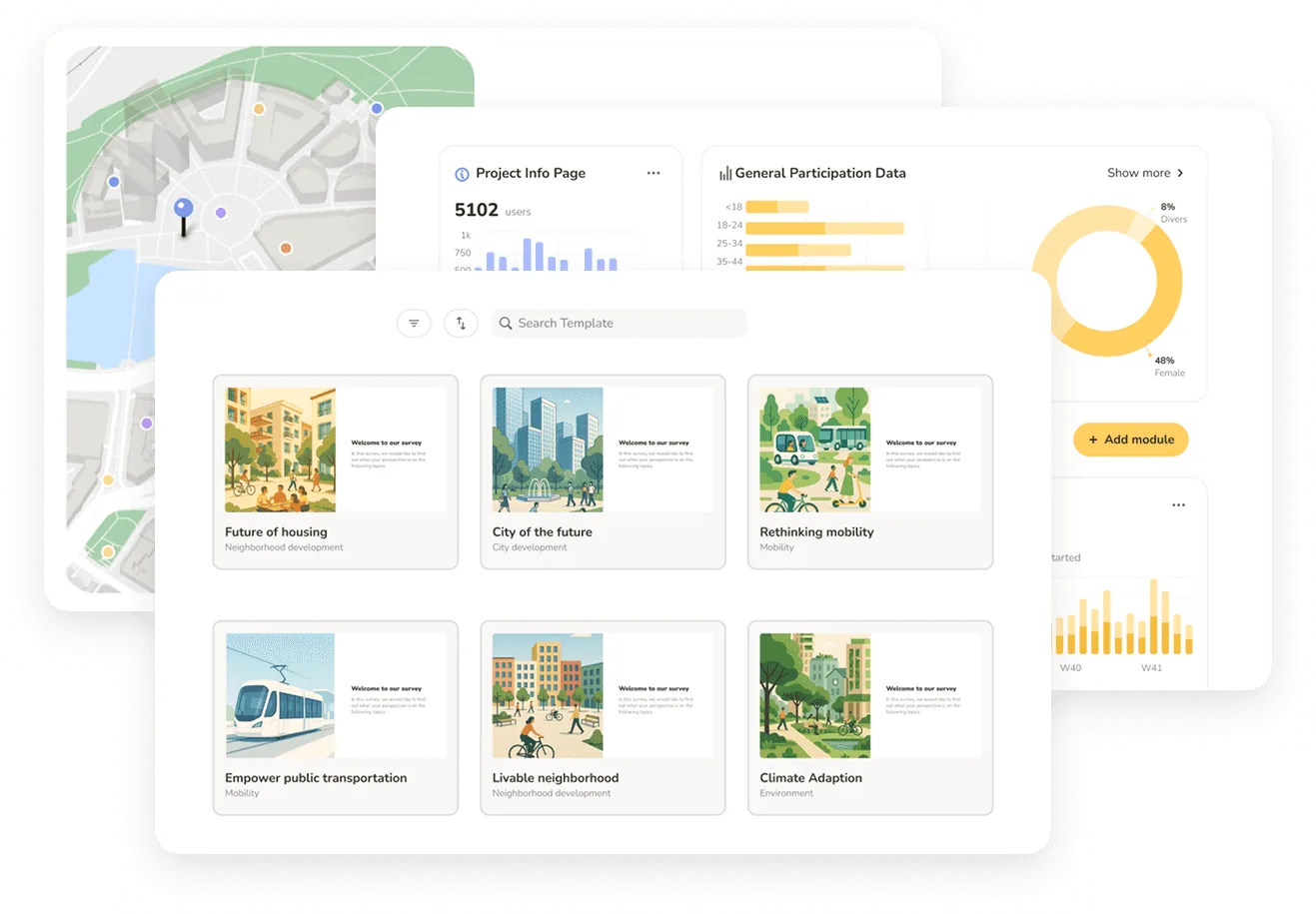
Start from the economic-segment requirement and work backward. Identify the renter and lower-income populations in the jurisdiction, the languages spoken, and the community organizations that already have their trust, then build the outreach plan to reach them specifically. A digital, map-based platform helps here because it lowers the barrier to participation: residents can contribute on their own time, from a phone, in their own language, without attending a meeting they cannot get to.
Capture input as structured data from the start
Every comment should arrive already attached to a location, a topic, and a timestamp rather than being sorted later. Map-based questions are especially useful for housing because they let residents point to where they want — or do not want — growth, density, or new development, which is far more actionable than a general comment box. Structured input is also what makes the input-to-element chain possible, because each theme can be traced back to the comments behind it.
Analyze continuously, not at the deadline
The synthesis bottleneck disappears when analysis runs alongside collection instead of after it. Senf's native AI analysis groups open-text responses into themes as they come in, so the engagement lead is reviewing emerging findings throughout the comment window rather than facing a wall of raw text at the end. The firm's expertise still drives the conclusions; the platform removes the manual sorting that usually eats the schedule.
Produce the engagement record as you go
Because participation, locations, themes, and timestamps are captured in one place, the outreach summary and supporting appendix are a product of the work rather than a separate scramble at the end. When HCD asks how input shaped the element, the answer is already documented.
Where Senf fits
Senf is an AI-native community engagement platform built for private-sector planning, design, and engineering consultancies. For a Housing Element update, that means one place to run map-based public input, reach residents in multiple languages, analyze open-text responses into themes natively, and produce a client-ready engagement record — the same platform from outreach through reporting. The point is not to replace the planner's judgment about what the community said. It is to make sure the firm can prove the diligent effort the state requires, without losing days to manual synthesis or end-of-project documentation.
If your firm is preparing a Housing Element update and wants the engagement record to be the strongest part of the submittal rather than the weakest, the demo below walks through what that looks like on a real project.